
How to Build a Music Practice Routine You Can Follow
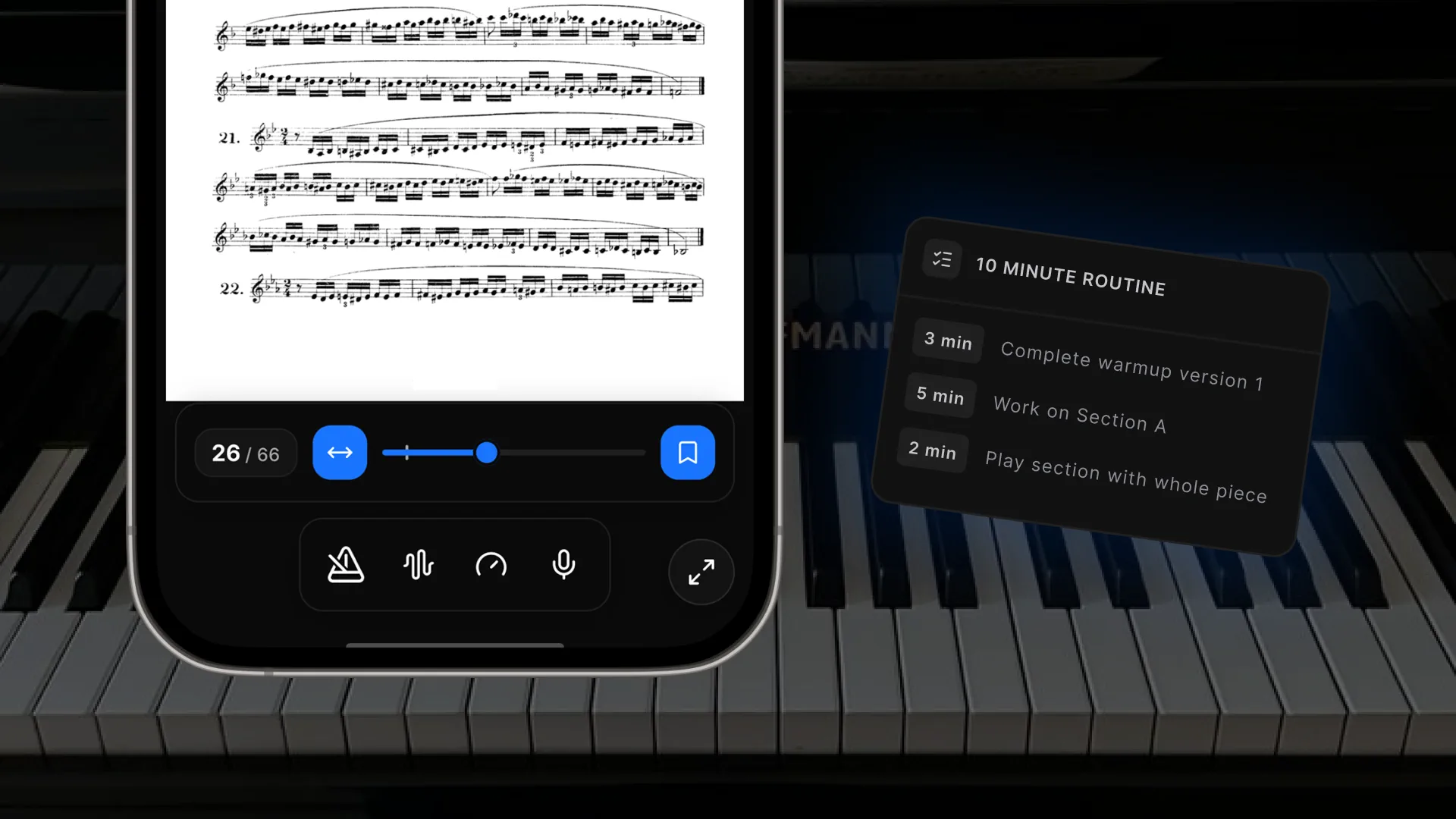
Table of contents9 sections
- Start With One or Two Clear Practice Goals
- Choose a Practice Length You Can Repeat
- Build Your Music Practice Routine in Four Parts
- Example 30-Minute Music Practice Routine
- Create a 10-Minute Backup Routine
- Plan Your Practice Across the Week
- Adjust the Routine When It Stops Working
- Avoid Common Practice Routine Mistakes
- Track What You Practise
A useful music practice routine tells you what to work on, how to divide your available time, and what to do next. It removes the daily question of “What should I practice?” without locking you into a rigid schedule.
Choose one or two clear goals, then divide your session between preparation, technique, focused problem-solving, and repertoire. Keep the routine short enough to repeat consistently, and prepare a backup version for days when time is limited.
Start With One or Two Clear Practice Goals
Before assigning time to warmups, exercises, and pieces, decide what you want the session to accomplish.
A broad goal such as “get better at guitar” does not tell you what to do. A specific goal helps you choose the right material and decide where to spend the most time.
Useful music practice goals include:
- Play a difficult eight-measure passage cleanly at 80 BPM.
- Perform a scale evenly in three keys.
- Prepare two assigned pieces for the next lesson.
- Sight-read for five minutes without restarting after mistakes.
- Maintain a consistent tone through four long notes.
- Memorize the first section of a piece.
You may have several long-term goals, but one session should usually emphasize only one or two priorities. Trying to improve everything at once often leads to unfocused repetition.
A useful practice goal identifies:
- The material or skill you will work on.
- The specific change you want to make.
- The result that will show progress.
“Practice scales” is an activity. “Play the G major scale evenly at 72 BPM three times without a missed note” is a clear goal.
Choose a Practice Length You Can Repeat
Build your routine around the time you regularly have, not the time you wish you had.
A focused 20-minute session repeated throughout the week is more useful than an ambitious 90-minute plan you regularly avoid. Because your schedule may change, create both a standard routine and a shorter backup version.
| Session | Available Time | Main Focus |
|---|---|---|
| Short | 10–15 minutes | One priority and one piece |
| Standard | 25–40 minutes | Technique, focused work, and repertoire |
| Extended | 45–60 minutes | Multiple goals, detailed work, and review |
A shorter routine is not a failed version of your normal practice. It protects continuity and keeps your most important work moving forward.
Build Your Music Practice Routine in Four Parts
Most beginner and intermediate musicians can organize a session around four sections:
- Preparation
- Technique
- Focused problem-solving
- Repertoire and review
The time assigned to each section should reflect your current goal. You do not need to divide the session equally.
1. Prepare Your Body, Instrument, and Attention
Use the first few minutes to settle into the session. Preparation should help you begin focused work, not become a long routine of its own.
Depending on your instrument, you might:
- Check your posture, hand position, or instrument setup.
- Take a few calm breaths or complete a breathing warmup.
- Review the goal for the session.
- Play long tones, open strings, or relaxed chord changes.
- Set out the correct sheet music and practice materials.
- Set the metronome to your starting tempo.
In a 30-minute session, three to five minutes may be enough.
2. Practice Technique With a Specific Purpose
Technique practice develops skills that apply across multiple pieces. Depending on your instrument, it may include:
- Scales and arpeggios
- Chord changes
- Rudiments
- Bowing patterns
- Articulation exercises
- Breath control
- Finger coordination
- Picking patterns
- Rhythm exercises
Choose exercises that support your current music rather than collecting drills without a clear reason.
For example, a pianist working on uneven sixteenth notes might practise a related scale slowly with a metronome. A guitarist preparing difficult chord changes might isolate two chords and repeat only the movement between them. A wind player working on a lyrical passage might focus on steady airflow and connected articulation.
Replace vague time blocks with measurable tasks. Instead of writing “technique: 10 minutes,” use a target such as:
- Play two scales at 60 BPM with an even rhythm.
- Practise one sticking pattern at three controlled tempos.
- Complete five relaxed transitions between two chords.
- Play one bowing pattern on open strings with a steady tone.
3. Focus on a Small, Difficult Section
Playing a piece from beginning to end can feel productive, but it often repeats mistakes without solving them. Focused work on one small problem is usually more valuable.
Choose a passage and identify what is going wrong. The issue might involve:
- Incorrect notes
- Uneven rhythm
- Unclear articulation
- Poor coordination
- Inconsistent tone
- An awkward shift or position change
- A memory gap
- Tension at a faster tempo
Then reduce the difficulty. Work on two to four measures, lower the tempo, simplify the rhythm, separate the hands, or isolate the transition between two notes.
- Choose the smallest section that contains the problem.
- Identify one issue to listen for.
- Lower the tempo until you can play with control.
- Repeat the section accurately three times.
- Reconnect it to the measures before and after it.
- Increase the tempo only when the passage remains controlled.
Ask a specific question after each attempt: Was the rhythm more even? Did the transition feel easier? Did the same mistake return?
4. Finish With Repertoire and a Quick Review
Use the final part of the routine to reconnect detailed work to a longer musical section.
You might play:
- The complete section containing today’s difficult passage.
- One current piece without stopping.
- An older piece you want to retain.
- A short sight-reading example.
- Something familiar that keeps the session enjoyable.
Leave one or two minutes to review the session:
- What improved?
- What still breaks down?
- What should you begin with next time?
- Should you keep, lower, or raise the current tempo?
- Does the routine need to change?
A brief note creates continuity between sessions. Instead of trying to remember where you stopped, you can begin your next session with a clear action.
Example 30-Minute Music Practice Routine
This routine gives a beginner or intermediate musician time for technique, focused problem-solving, and repertoire.
| Section | Time | Example |
|---|---|---|
| Preparation | 3 minutes | Set up, check posture, and warm up |
| Technique | 7 minutes | Practise scales, rhythm, or a relevant exercise |
| Difficult passage | 12 minutes | Isolate, slow down, correct, and reconnect one section |
| Repertoire | 6 minutes | Play a longer section or review an older piece |
| Reflection | 2 minutes | Record progress and choose the next priority |
Treat the plan as a starting point rather than a fixed formula.
Before a performance, you may spend more time playing complete pieces. When developing a physical skill, technique may take a larger share. Before a lesson, you might prioritize your teacher’s assignments and write down questions.
Create a 10-Minute Backup Routine
A backup routine helps you continue practising when your normal schedule changes.
Do not try to squeeze every part of a full session into ten minutes. Choose the work that matters most.
- Set up and choose one clear goal 1 minute
- Complete a focused warmup 2 minutes
- Work on the most important passage or skill 5 minutes
- Play it in context and write the next step 2 minutes
You can also use a minimum-session rule: open your music and work on one passage. You may decide to continue, but the smaller commitment makes it easier to begin.
Plan Your Practice Across the Week
A daily routine becomes more useful when it supports a weekly goal.
Every session does not need to contain the same material. Keep one main priority consistent while rotating secondary tasks such as technique, recording, sight-reading, or repertoire review.
- Monday Learn the notes and rhythms in a new section.
- Tuesday Work on a technical skill connected to the section.
- Wednesday Practise difficult transitions with a metronome.
- Thursday Record and review a longer attempt.
- Friday Address the problems you heard in the recording.
- Saturday Play through the piece without stopping.
- Sunday Review the week and choose the next priority.
A weekly review can reveal imbalances. You may discover that you spend most of your time playing familiar pieces while avoiding technique, sight-reading, or difficult passages.
Adjust the Routine When It Stops Working
A practice routine should provide structure, not become a rule you follow without thinking.
Review the plan when:
- You repeatedly run out of time.
- The same section always gets skipped.
- Your goals have changed.
- A lesson, performance, or audition is approaching.
- You repeat exercises without knowing why.
- The same musical problem continues.
- The routine feels too demanding to begin.
Change one part at a time. Shorten a section, replace an exercise, choose a clearer goal, or move your hardest work earlier in the session.
Your routine should evolve with your skills and musical priorities.
Avoid Common Practice Routine Mistakes
Trying to Cover Too Much
A long list of pieces and exercises can divide your attention until no task receives meaningful work. Choose fewer priorities and work on them carefully.
Measuring Only Minutes
Practice time shows consistency, but it does not explain what changed. Track another measure such as tempo, accuracy, completed sections, or a written observation.
Always Starting at the Beginning
When you repeatedly begin with the opening of a piece, later sections receive less attention. Start with the passage that needs the most work.
Increasing the Tempo Too Soon
Faster playing can hide uneven rhythm, tension, and inefficient movement. Raise the metronome only after you can repeat the section with control at the current tempo.
Repeating Without Listening
Repetition is useful only when each attempt has a purpose. Pause, identify what changed, and choose an adjustment before playing again.
Never Reviewing the Plan
A routine that worked several months ago may no longer fit your current music. Review it regularly and remove tasks that no longer support your goals.
Track What You Practise
You do not need a complicated tracking system. After each session, record:
- What you worked on
- How long you practised
- The tempo or another measurable result
- What improved
- What still needs attention
- What to do next
This creates a clear link between sessions and makes it easier to restart after a break.
PracticePal AI is a music practice app that lets you build routines from saved pieces and exercises, add BPM goals, and review how your practice time is distributed in the Progress Tracker.
Keep the routine focused on a few priorities, record the next step after each session, and adjust the plan as your playing develops.
For your next practice session, choose one clear musical goal and divide your available time between preparation, technique, focused work, and review.
FAQ
Frequently asked questions
A useful routine usually includes brief preparation, goal-based technique work, focused practice on a difficult passage, repertoire, and a short review.
Choose a duration you can repeat consistently. A focused 20- or 30-minute routine is more useful than a longer plan you regularly avoid.
Choose one priority, complete a brief warmup, work on the most important passage or skill, and leave a note for your next session.