
Music Practice Goals for Musicians Who Feel Stuck
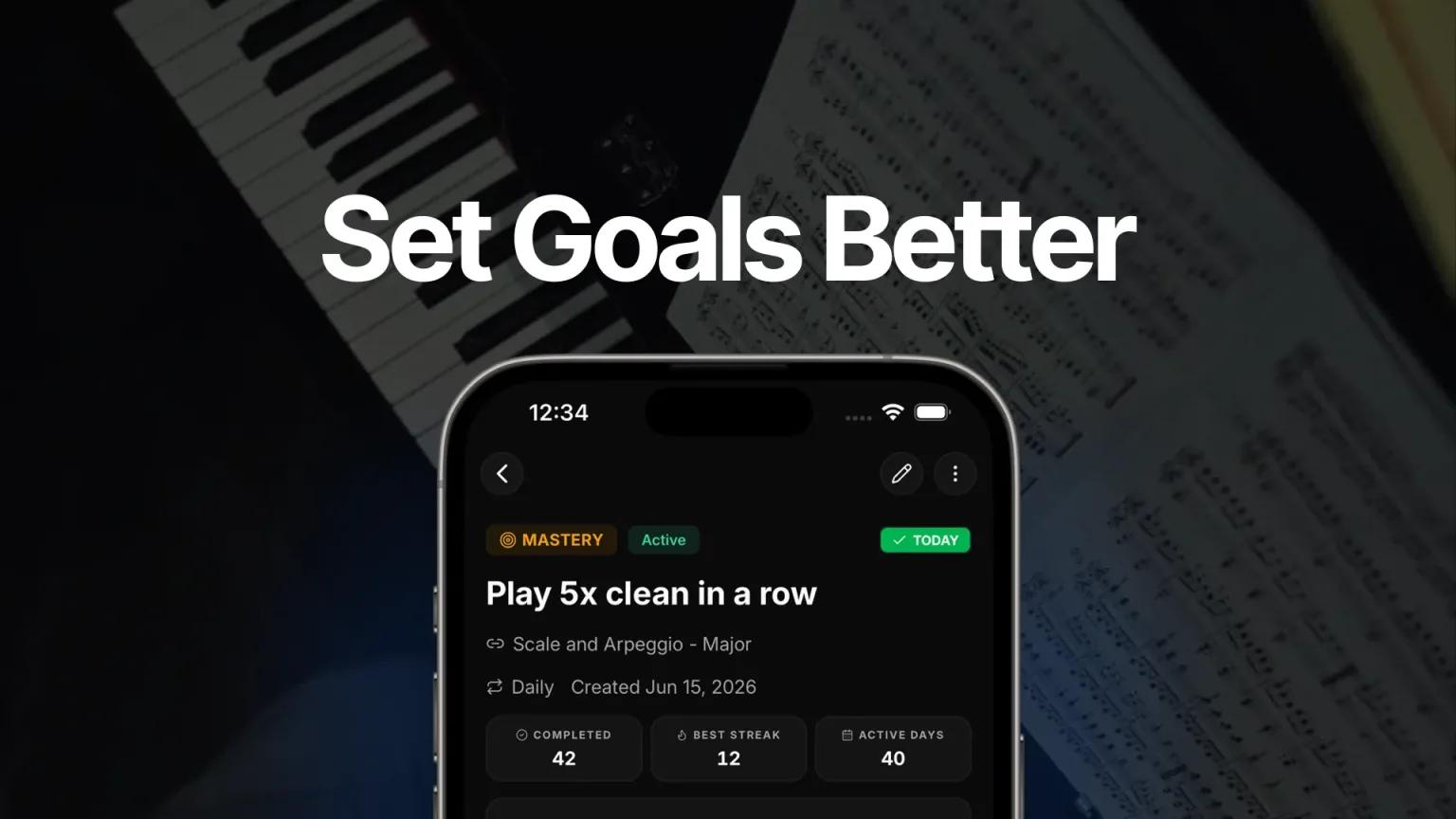
Advancing musicians often reach a frustrating point: they know more than they did as beginners, but they also hear more problems in their playing. Improvement can feel slower because the remaining changes are smaller and harder to notice.
Useful music practice goals make that progress visible. Choose one specific problem, decide what action you will take, and define what will count as completion.
Why advancing musicians often feel stuck
Early progress is easy to recognize. You learn a scale, complete a piece, or play a difficult chord for the first time.
Later progress may involve cleaner articulation, steadier rhythm, better tone, more reliable memory, or stronger phrasing. These improvements matter, but they are less obvious.
This confidence dip is sometimes associated with the Dunning-Kruger effect. As your understanding grows, you become more aware of what you cannot yet do. That does not necessarily mean your playing has stopped improving.
The answer is to replace broad judgments with goals that produce clear evidence.
How to set a useful music practice goal
A large goal can provide direction, but it rarely tells you what to do today.
For example:
Broad goal: Play the piece confidently.
A more useful goal would be:
Focused goal: Play measures 17–24 five times cleanly at 72 BPM without stopping.
Build each goal from three parts:
- Scope: Name one piece, exercise, or section.
- Action: State what you will do.
- Evidence: Define what will count as completion.
Example: “Play measures 17–24 five times cleanly at 72 BPM.”
Avoid turning a practice problem into a judgment about yourself. Instead of saying, “I have bad rhythm,” identify the observable issue: “I rush the eighth notes when the metronome reaches 104 BPM.”
A specific problem gives you a practical next step.
Music practice goal examples
Goals can measure more than speed or repetition. They can also support memory, expression, consistency, and endurance.
| Practice Need | Focused Goal | Evidence |
|---|---|---|
| Accuracy | Play measures 25–32 five times without a missed note | Five clean repetitions |
| Tempo | Move the scale from 88 to 92 BPM while staying relaxed | One controlled repetition |
| Memory | Begin the second section without looking at the score | Successful start from memory |
| Expression | Shape the phrase with a clear rise and release | Review one recording |
| Consistency | Practice the étude on Monday, Wednesday, and Saturday | Three completed check-ins |
| Sight-reading | Read one unfamiliar page without restarting | One complete pass |
Match the evidence to the skill. Repetition counts work well for accuracy, while expression goals may need a recording or simple check-in.
Keep the scope small enough to practice directly. “Memorize the sonata” is too broad for one session. “Play the opening eight measures from memory” is easier to act on and review.
How goals work in PracticePal
In PracticePal AI, every goal belongs to a practice material, such as a song, exercise, scale, or étude.
You must create the material before you can add a goal. A material can have multiple goals, so one piece might have separate targets for accuracy, memory, expression, and consistency.
To create a goal:
- Open or create the relevant practice material.
- Open the material screen.
- Select the Goals tab.
- Press the + button at the bottom right.
- Choose a ready-made template or create a custom goal.
- Complete the relevant fields.
- Save the goal.
Templates are grouped into technique, repertoire, sight-reading, rhythm, warmups, and ear training. A goal can apply to the whole material or to one optional section.
PracticePal does not calculate progress from your playing or practice time. You move a goal forward by checking it off manually during or after a session.
The five PracticePal goal types
| Goal Type | Use It For | Tracking |
|---|---|---|
| Mastery | Clean repetitions or repeated attempts | Numeric target |
| Memorization | Working on a piece or section from memory | Yes-or-no check-in |
| Expression | Dynamics, phrasing, tone, or musical character | Yes-or-no check-in |
| Consistency | Practicing on selected days | Scheduled check-ins |
| Custom | Counting reps, measures, or pages | Numeric target with a chosen unit |
Mastery works for goals such as playing a passage five times cleanly.
Memorization records whether you worked on memorizing the material that day.
Expression tracks work on phrasing, dynamics, tone, or feel.
Consistency tracks whether you practiced the material on your selected days.
Custom works like Mastery but lets you count reps, measures, or pages.
Keep the goal setup simple
Use only the settings that make the goal easier to understand or complete.
Start with a clear title and the goal type that matches the work. Add a numeric target only when counting repetitions, measures, or pages gives you useful evidence. Consistency goals create their target from the days you select.
Use the optional Section setting when the goal applies to one passage rather than the whole material. It labels the scope but does not change how progress is tracked.
Choose Once for a specific achievement. Use daily, weekly, or monthly repetition when the goal represents work you plan to revisit.
A reminder can help when the timing matters, but a deadline is only a reference date. Passing it does not expire the goal or change its status.
Add notes only when they will help during practice, such as a starting BPM, teacher instruction, fingering choice, or reminder about what to listen for.
A one-time goal is marked complete when it reaches its target. Repeating goals rely on your check-ins and do not gain progress automatically from your playing or total practice time.
Use a small set of balanced goals
You do not need a goal for everything. For one important material, two or three goals are usually enough to cover different types of work.
- Monday Complete three clean repetitions of measures 17–24 at 72 BPM.
- Wednesday Practice the same section from memory.
- Friday Record the section and review its phrasing.
- Sunday Decide whether to raise the tempo, expand the section, or repeat the goal.
This creates clearer feedback than one large goal such as “finish the section.”
When you complete a goal, check the quality before making it harder. Raise the tempo or expand the section only when the result remains controlled and repeatable.
Use goals to guide the next session
A goal is not a judgment of your talent. It is a decision about where to place your attention.
Create the material in PracticePal AI, open its Goals tab, and press the + button at the bottom right. Choose the goal type that matches the work, narrow it to a section when helpful, and add only the settings you need.
During your next practice session, choose one material and one small problem. Write a goal that defines the scope, action, and evidence of completion.
FAQ
Frequently asked questions
A good music practice goal names one material or section, one specific action, and a clear way to recognize completion. For example: play measures 12–20 four times cleanly at 80 BPM.
Start with one to three goals for your most important material. Too many goals can make practice feel administrative instead of focused.
No. Deadlines are useful for auditions, performances, lessons, or other fixed dates, but many technique and consistency goals work better as recurring targets.
Yes. One material can have several goals, such as a Mastery goal for clean repetitions, a Memorization goal for one section, and an Expression goal for phrasing.