
Why You Should Record Yourself Practicing an Instrument
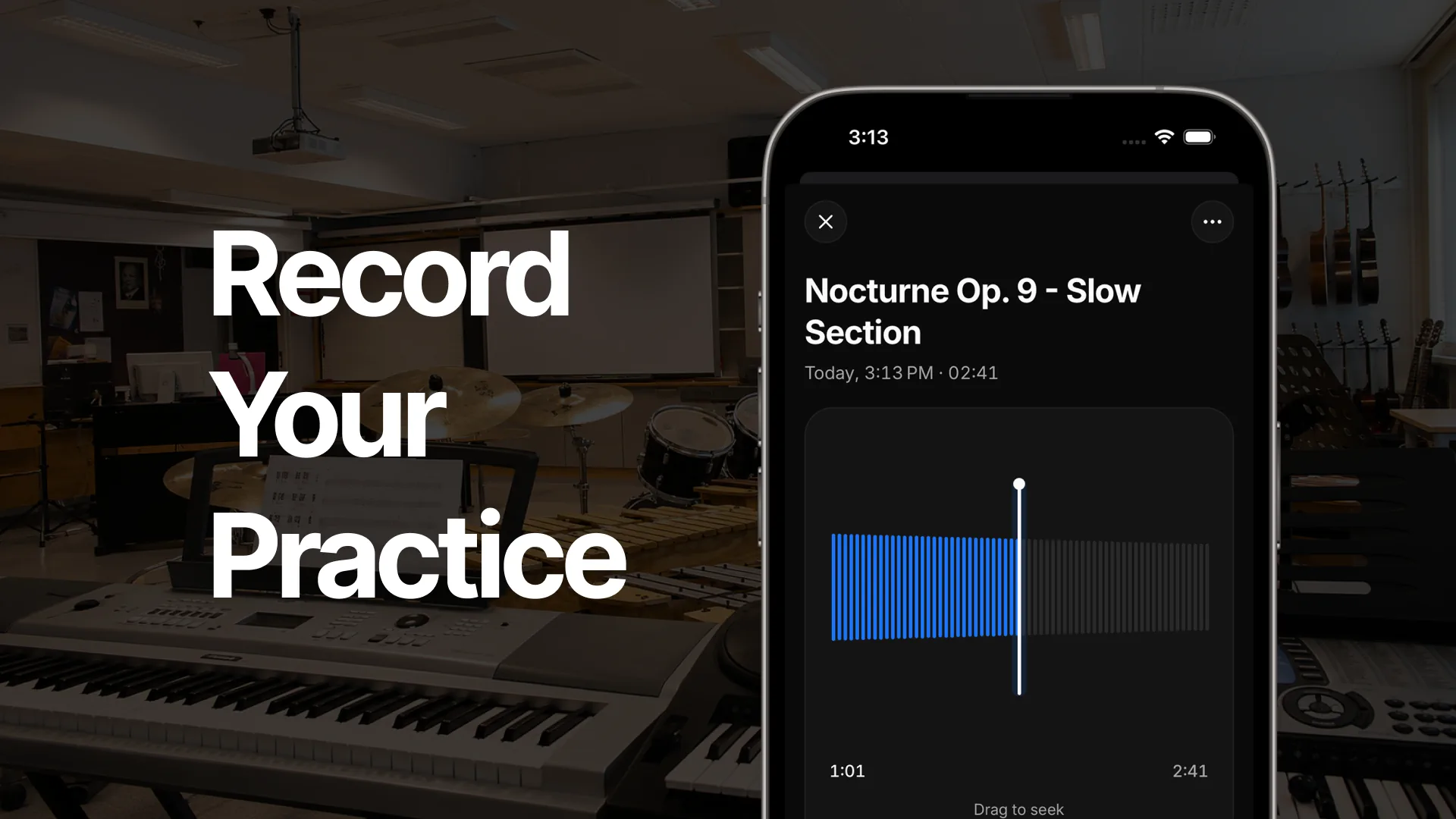
Table of contents10 sections
- Why record yourself practicing?
- What can a practice recording reveal?
- Use the Record–Listen–Notice–Adjust–Compare method
- Ask one question before pressing record
- How long should a practice recording be?
- How often should you record practice?
- How to compare recordings fairly
- Common recording mistakes
- What if you dislike hearing yourself play?
- Keep recordings connected to your practice goal
Recording yourself practicing helps you hear details that are difficult to notice while you are concentrating on playing. A short recording can reveal unstable timing, uneven transitions, unclear articulation, changes in tone, or differences between what a passage feels like and how it actually sounds.
The most useful practice recordings are not full-session archives. They are short, focused attempts made for a specific reason: to answer one question, choose one adjustment, and compare the result.
Why record yourself practicing?
Recording creates distance between playing and evaluating.
While you play, your attention may be divided among reading, fingering, breathing, coordination, rhythm, posture, and sound. When you listen afterward, you no longer need to manage those physical tasks. You can focus on one musical detail at a time.
A recording can help you:
- Hear whether your tempo remains steady.
- Check whether articulations and note endings sound clear.
- Compare several attempts made under similar conditions.
- Preserve evidence of gradual progress.
- Decide what to change during the next repetition.
You do not need studio equipment for this kind of review. A phone recording is usually enough to evaluate broad features such as timing, consistency, balance, articulation, and musical direction.
What can a practice recording reveal?
A recording is most useful when you know what you are listening for. Choose one category before pressing record rather than trying to assess the entire performance.
Timing and tempo
Listen for rushing, dragging, pauses, or changes in pulse.
A transition may feel controlled while you are playing but sound hesitant when you listen back. You may also discover that you speed up during easier measures and slow down when the music becomes more difficult.
When tempo is the main goal, record at a known metronome setting. That gives you a clear reference for later comparisons.
Accuracy and consistency
Listen for mistakes that happen in the same place more than once.
One wrong note may be an isolated slip. A mistake that appears in the same measure across several takes is more likely to point to a fingering, rhythm, coordination, breathing, or reading problem that needs focused work.
Tone and articulation
Listen for note beginnings, endings, connection, steadiness, and unintended accents.
Ask yourself a narrow question. For example:
- Do the notes begin clearly?
- Does the tone remain steady through the phrase?
- Are the short notes equally short?
- Do connected notes remain smooth?
- Does one note consistently sound louder than the others?
Musical shape
Listen for whether the phrase has direction.
Dynamics that feel dramatic while you play may sound less noticeable on playback. A phrase may also lose energy before its destination, or repeated sections may sound too similar.
Try asking:
- Can I hear the dynamic contrast?
- Does the phrase continue through the difficult measure?
- Is the arrival point clear?
- Does the repeated section sound intentionally different?
| Practice Goal | Listen For | Useful Next Action |
|---|---|---|
| Steadier tempo | Rushing, dragging, or pauses | Lower the tempo and repeat the unstable transition |
| Cleaner passage | Repeated note or rhythm errors | Isolate the smallest section that breaks down |
| Clearer articulation | Blurred attacks or uneven releases | Practice the articulation on fewer notes |
| Stronger phrasing | Flat dynamics or unclear direction | Mark one phrase peak and record another take |
| Better consistency | Large differences between attempts | Repeat the same passage under similar conditions |
Use the Record–Listen–Notice–Adjust–Compare method
Recording alone does not improve a passage. The value comes from turning what you hear into a specific practice decision.
Use this five-step process:
- Record: Choose one passage, exercise, scale, or short run.
- Listen: Play the recording back without playing along.
- Notice: Identify one specific issue or improvement.
- Adjust: Change one practice variable.
- Compare: Record another take under similar conditions.
The adjustment might be:
- Lowering the tempo.
- Practicing fewer measures.
- Changing a fingering.
- Moving a breath.
- Exaggerating a dynamic contrast.
- Reducing tension in a difficult movement.
Change only one main variable before recording again. When you change the tempo, fingering, articulation, and section length at the same time, it becomes difficult to know which adjustment helped.
- 1 minute Choose one passage and one listening question.
- 1 minute Record one complete attempt without stopping.
- 1 minute Listen once and write down one observation.
- 1 minute Practice the smallest section connected to that observation.
- 1 minute Record another attempt and compare the same detail.
Ask one question before pressing record
A vague recording often leads to vague criticism.
Before you begin, decide what the recording should help you learn. A useful listening question is specific enough to answer after one playback.
Examples include:
- Does the tempo stay steady through the transition?
- Are the note endings together?
- Can I hear the difference between the two dynamics?
- Does the phrase continue through the breath or shift?
- Is the final repetition more controlled than the first?
- Does the passage still sound tense at the slower tempo?
- Are the repeated notes even?
- Does the rhythm remain clear without the metronome?
A great question points toward a decision. “Does the tempo slow down in measures 12–14?” tells you where to listen and what you may need to practice next.
How long should a practice recording be?
Use the shortest recording that answers your question/concern.
For a difficult transition, 10 to 20 seconds may be enough. For phrasing, you may need an entire musical sentence. For endurance or performance preparation, you may occasionally record a full movement, song, or audition run.
Full run-throughs still have a place, especially before a lesson, rehearsal, audition, or performance. They answer different questions, such as whether you can maintain concentration, pacing, and consistency over a longer span.
How often should you record practice?
There is no single correct schedule.
For most sessions, one or two short recordings are enough. Record when hearing the result will help you make a decision, not simply because you feel that every session should be documented.
Recording too frequently can interrupt concentration. When you already know what needs work, stop reviewing and return to practicing.
How to compare recordings fairly
Two recordings are easier to compare when the main conditions remain similar.
Use the same passage, starting point, and listening target. When tempo matters, use the same BPM for both takes. A faster version may sound more exciting, but it is not a fair comparison if you are trying to judge control or accuracy.
Place your phone or recording device in roughly the same position. This does not need to be exact, but large changes in distance or room placement can affect the captured sound.
- Record the same passage or exercise
- Note the tempo when tempo matters
- Place the device in a similar position
- Use one listening question
- Save one clear observation
- Choose one action for the next session
Label recordings so you can identify them later. A simple format is:
piece or exercise – section – tempo
For example:
Minuet – measures 17–24 – 72 BPM
Add one note about the take:
- What improved?
- What still needs attention?
- What will you change next time?
Without that context, a folder full of recordings may become difficult to use.
Common recording mistakes
Recording is less useful when it becomes a substitute for focused practice.
Avoid these common problems:
- Recording an entire session without a review purpose.
- Stopping the take every time you make a mistake.
- Listening only for errors.
- Changing several practice variables before recording again.
- Comparing takes made at very different tempos.
- Treating phone audio as a perfect representation of tone.
- Saving recordings without labels or notes.
- Replaying the same take repeatedly without choosing a next action.
One imperfect take can still be useful. The goal is not to produce a performance worth keeping. The goal is to collect enough information to make the next repetition more focused.
What if you dislike hearing yourself play?
Start with a very short passage and listen for one neutral fact.
Instead of deciding that the recording “sounds bad,” describe what happened.
Specific language separates the observation from a general judgment about your ability.
You also do not need to keep every recording. Save the takes that show a useful starting point, a meaningful change, or a result you want to compare later.
Keep recordings connected to your practice goal
A recording becomes more useful when it stays connected to the passage, tempo, note, and decision that produced it.
PracticePal AI includes an audio recorder for capturing practice sessions and organizing recordings by material, section, or instrument. You can also use practice notes to preserve what you heard and what you plan to change during the next session.
Save the recording with the relevant piece or section, then add one note about what you heard and what you will change next. Comparing similarly labeled takes later is more useful than keeping an unorganized folder of audio files.
Choose one passage that regularly feels inconsistent. Record one attempt, listen for one specific detail, make one adjustment, and record it again.
FAQ
Frequently asked questions
A recording lets you listen without also managing the physical and mental demands of playing. This can make timing, tone, articulation, phrasing, and repeated mistakes easier to notice.
For most practice reviews, a phone recording is sufficient. It may not capture tone perfectly, but it can still help you evaluate timing, consistency, articulation, and musical shape.
One or two short, purposeful recordings during a session are often more useful than recording the entire practice session.
Choose one listening target, such as steady tempo, accurate rhythm, clear articulation, even tone, or a specific phrase. Avoid trying to evaluate every part of the performance at once.